
Introduction
Pepper farming is a highly profitable agricultural enterprise that contributes significantly to food security, nutrition, and income generation. Widely cultivated for both fresh consumption and industrial processing, peppers command high market demand. However, pest infestations pose a constant threat to achieving optimal yields and produce quality by reducing plant vigor, causing direct crop losses, and driving up production costs.
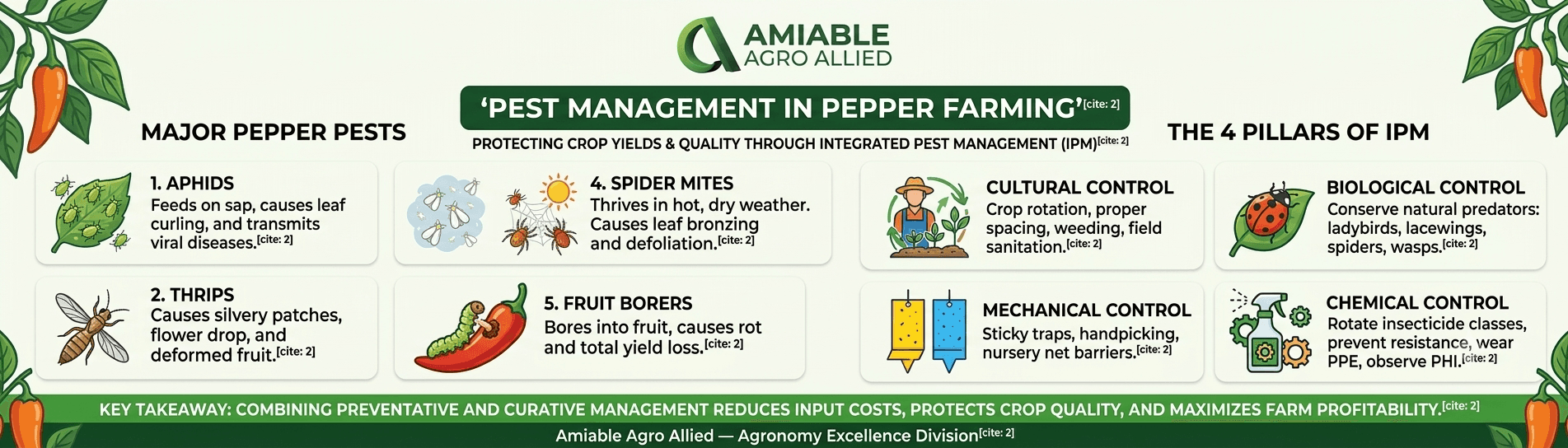
Implementing an Integrated Pest Management (IPM) strategy allows growers to combine preventive and curative methods—cultural, biological, mechanical, and chemical—to keep pest populations below economically damaging levels while minimizing environmental and health risks.
Table of Contents
Major Pests of Pepper
Aphids
Thrips
Whiteflies
Spider Mites
Fruit Borers
Integrated Pest Management (IPM) Strategies
Cultural Control
Biological Control
Mechanical & Physical Control
Chemical Control
Pest Control Quick-Reference Summary
Conclusion
1. Major Pests of Pepper
Aphids
Aphids are small, soft-bodied insects that feed on plant sap, typically targeting young leaves, stems, and flower buds.
Damage: Causes curling and distortion of leaves, stunted plant growth, reduced vigor, and transmission of viral diseases.
Management:
Inspect fields regularly for early signs of infestation.
Remove and destroy heavily infested plant parts.
Encourage beneficial insects such as ladybird beetles and lacewings.
Apply neem-based organic products.
Apply recommended insecticides when populations reach economic threshold levels.
Thrips
Thrips are microscopic insects that feed by scraping plant tissue and sucking plant juices.
Damage: Leaves silvery patches on foliage, causes flower drop, deformities in fruit, and vectors destructive viral diseases.
Management:
Maintain field sanitation by clearing weeds that host pests.
Use reflective mulches to deter thrips where feasible.
Monitor populations with sticky traps.
Apply biological or chemical controls as needed.
Whiteflies
Whiteflies feed on plant sap and excrete honeydew, which leads to the development of sooty mold on foliage.
Damage: Weakens plants, reduces photosynthesis, and spreads viral pathogens.
Management:
Clear weeds around the perimeter of the farm.
Place yellow sticky traps for monitoring and population reduction.
Avoid excessive nitrogen fertilizer applications, which create lush foliage attractive to whiteflies.
Introduce natural predators like parasitoid wasps.
Apply approved insecticides when threshold levels are exceeded.
Spider Mites
Spider mites are tiny pests that thrive in hot, dry climatic conditions.
Damage: Feeds on leaf tissue causing yellow spotting, leaf bronzing, and premature defoliation, leading to severe yield reductions.
Management:
Maintain adequate soil irrigation to minimize plant stress.
Increase humidity around plants where possible.
Remove heavily infested leaves promptly.
Use targeted miticides if severe outbreaks occur.
Fruit Borers
Fruit borers are caterpillars that bore directly into pepper fruits.
Damage: Causes direct fruit loss and opens wounds for secondary fungal or bacterial infections, rendering produce unmarketable.
Management:
Practice strict crop rotation schedules.
Install pheromone traps for pest monitoring.
Protect natural predators and parasitoids.
Apply suitable insecticides in accordance with extension service guidance.
Collect and destroy all infested fruits.
2. Integrated Pest Management (IPM) Strategies
Cultural Control
Cultural practices form the primary foundation of IPM by creating environmental conditions unfavorable to pest build-up:
Rotate crops with non-host plant species.
Time plantings strategically to avoid peak pest activity windows.
Maintain proper plant spacing to enhance air circulation.
Manage weeds timely to eliminate alternative pest hosts.
Transplant only healthy, disease-free seedlings.
Practice complete field sanitation by removing post-harvest crop residues.
Biological Control
Biological control leverages natural organisms to suppress pest populations:
Protect natural predators like ladybird beetles, predatory mites, spiders, lacewings, and parasitoid wasps.
Avoid indiscriminate broad-spectrum pesticide applications.
Maintain natural field borders and plant flowering plants to attract beneficial insects.
Mechanical and Physical Control
Mechanical controls offer non-chemical solutions to control pest levels:
Handpick and destroy infested plant tissues and fruits.
Install insect-proof net coverings over nursery seedbeds.
Deploy colored sticky traps to monitor and catch flying insects.
Chemical Control
Chemical measures are reserved for instances when pest pressure crosses economic thresholds:
Use only legally registered pesticide formulations.
Strictly follow container label instructions and safety guidelines.
Rotate active ingredients across different pesticide classes and modes of action to delay pest resistance.
Always wear appropriate Personal Protective Equipment (PPE) during application.
Adhere strictly to Pre-Harvest Intervals (PHI) before picking fruit.
3. Pest Control Quick-Reference Summary
Pest NamePrimary DamageKey IPM Control StrategyAphids
Leaf curling, virus transmission
Neem oil, beneficial insects, targeted insecticides
Thrips
Silvery leaves, deformed fruits
Reflective mulches, sticky traps, weed clearance
Whiteflies
Sooty mold, viral transmission
Yellow sticky traps, moderate nitrogen use, parasitoid wasps
Spider Mites
Leaf bronzing, defoliation
Consistent irrigation, elevated humidity, miticides
Fruit Borers
Bores into fruit, secondary rot
Sanitation, pheromone traps, fruit destruction, rotation
Conclusion
Managing major pests like aphids, thrips, whiteflies, spider mites, and fruit borers is critical to protecting pepper yields and quality. By committing to an Integrated Pest Management (IPM) approach—combining field sanitation, biological conservation, physical barriers, and targeted, responsible pesticide use—farmers can lower input risks, safeguard crop productivity, and build a long-term, profitable enterprise.