
• Introduction
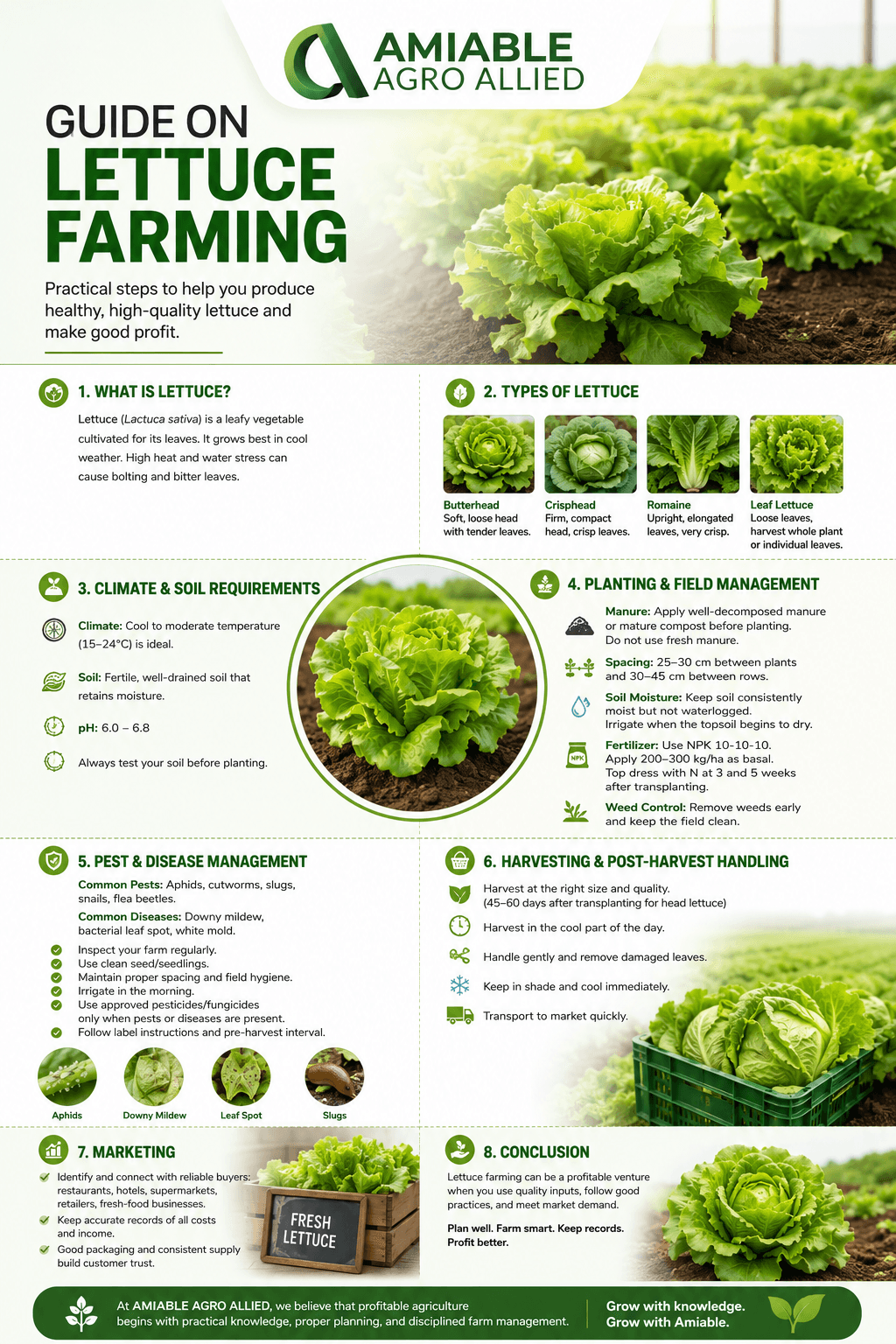
Lettuce is a fast-growing leafy vegetable widely used in salads, sandwiches, burgers, and other fresh foods. Its short production cycle and steady market demand make it an attractive crop for vegetable growers. However, good yield and quality depend on proper variety selection, soil preparation, irrigation, nutrition, and pest management.
•Table of Contents
1. What Is Lettuce?
2. Types of Lettuce
3. Climate and Soil Requirements
4. Planting and Field Management
5. Pest and Disease Management
6. Harvesting and Post-Harvest Handling
7. Marketing
8. Conclusion
1. What Is Lettuce?
Lettuce is a leafy vegetable scientifically known as *Lactuca sativa*. It belongs to the **Asteraceae family** and is mainly cultivated for its leaves. Depending on the variety, lettuce may produce a compact head, a loose head, or loose leaves suitable for repeated harvesting.
Lettuce is considered a cool-season crop. High temperatures and water stress can encourage bolting, which is premature flowering and can result in bitter, poor-quality leaves.
2. Types of Lettuce
• Butterhead Lettuce
Butterhead produces soft leaves that form a relatively loose head. It is valued for its tender texture and mild taste.
•Crisphead Lettuce
Crisphead varieties form firm, compact heads with crisp leaves and are commonly used for fresh-market consumption.
• Romaine Lettuce
Romaine produces an upright head with elongated, crisp leaves and is widely used in salads.
• Leaf Lettuce
Leaf lettuce produces loose leaves rather than a tightly formed head. Depending on the variety and market, individual leaves or the entire plant can be harvested.
Farmers should select varieties according to the production environment, intended harvest method, customer preference, and market demand.
3. Climate and Soil Requirements
Lettuce performs best under cool to moderate growing conditions. Excessive heat can accelerate bolting and increase bitterness, while water stress can reduce growth and quality. Selecting varieties suited to the local environment is therefore important.
• Soil Requirements
Lettuce performs well in fertile, well-drained soil that can retain adequate moisture. A soil pH around **6.0–6.8** is generally suitable. Soil testing is recommended before planting so that nutrient requirements can be properly assessed.
Avoid poorly drained areas because excessive moisture can encourage root and disease problems.
4. Planting and Field Management
Start with quality seed from a reliable source. Lettuce can be direct-seeded or raised in a nursery and transplanted. Prepare fertile, well-drained soil and apply **well-decomposed manure or mature compost** before planting. Avoid applying fresh manure directly to the planting bed.
Transplant healthy seedlings carefully, preferably during the cooler part of the day. For full-size lettuce, use a spacing of **25–30 cm between plants and 30–45 cm between rows**. Keep the soil consistently moist but not waterlogged, and irrigate when the soil begins to dry. Apply **NPK 10-10-10** according to soil-test recommendations and divide the required nitrogen into split applications during crop growth. Control weeds early to reduce competition.
5. Pest and Disease Management
Common lettuce pests include aphids, cutworms, slugs, snails, and flea beetles. Diseases such as downy mildew, bacterial leaf spot, and white mold can also affect production.
Regular field inspection, good sanitation, proper spacing, weed control, healthy planting materials, and careful irrigation are important first steps. Protect beneficial insects and use approved pesticides or fungicides when pest or disease levels require treatment, following the product label and required pre-harvest interval.
6. Harvesting and Post-Harvest Handling
Harvest lettuce when it reaches the size and quality required by the target market. Depending on the variety, farmers can harvest individual leaves, baby leaves, or the whole plant.
Harvest during the cooler part of the day, handle the crop gently, remove damaged leaves, keep produce away from excessive heat, and transport it to market quickly because lettuce is highly perishable.
7. Marketing
Before planting, identify potential buyers such as restaurants, hotels, supermarkets, vegetable retailers, and fresh-food businesses. Keep records of seed, fertilizer, labour, irrigation, pest-control, packaging, transportation, and other costs so that the profitability of each production cycle can be properly assessed.
8. Conclusion
Lettuce farming can be a rewarding vegetable enterprise when farmers combine quality planting materials with proper soil preparation, consistent irrigation, balanced nutrition, effective pest and disease management, and good post-harvest handling. Most importantly, production should be guided by market demand and accurate farm records.
At **Amiable Agro Allied**, we believe that profitable agriculture begins with practical knowledge, proper planning, and disciplined farm management.