
Table of Contents
•The Cost Structure Problem
Seed Quality and Sourcing
Fertilizer, Pesticide, and Fungicide Efficiencies
Irrigation as a Profit Driver
•Smart Farming as an Economic Tool
Precision Monitoring and Input Optimization
Impact on Net Farm Income
•Market Intelligence and Value Chain Economics
Navigating Price Volatility
Value Addition: Drying, Grinding, and Branding
•Risk, Returns, and the Investment Case
Scaling Smart Technologies for Profitability
INTRODUCTION
Pepper has many forms, from the fiery scotch bonnet to the sweet bell and the pungent cayenne. It is one of the most economically significant spice crops in the world,Yet for most smallholder farmers, especially across sub-Saharan Africa and Southeast Asia, pepper farming remains a game of chance, high potential, higher risk, and chronic underperformance. The emergence of “smart pepper farming” a fusion of precision agriculture, data analytics, and market intelligence is beginning to rewrite this story, turning a traditionally volatile enterprise into a more predictable and profitable one.
The Cost Structure Problem
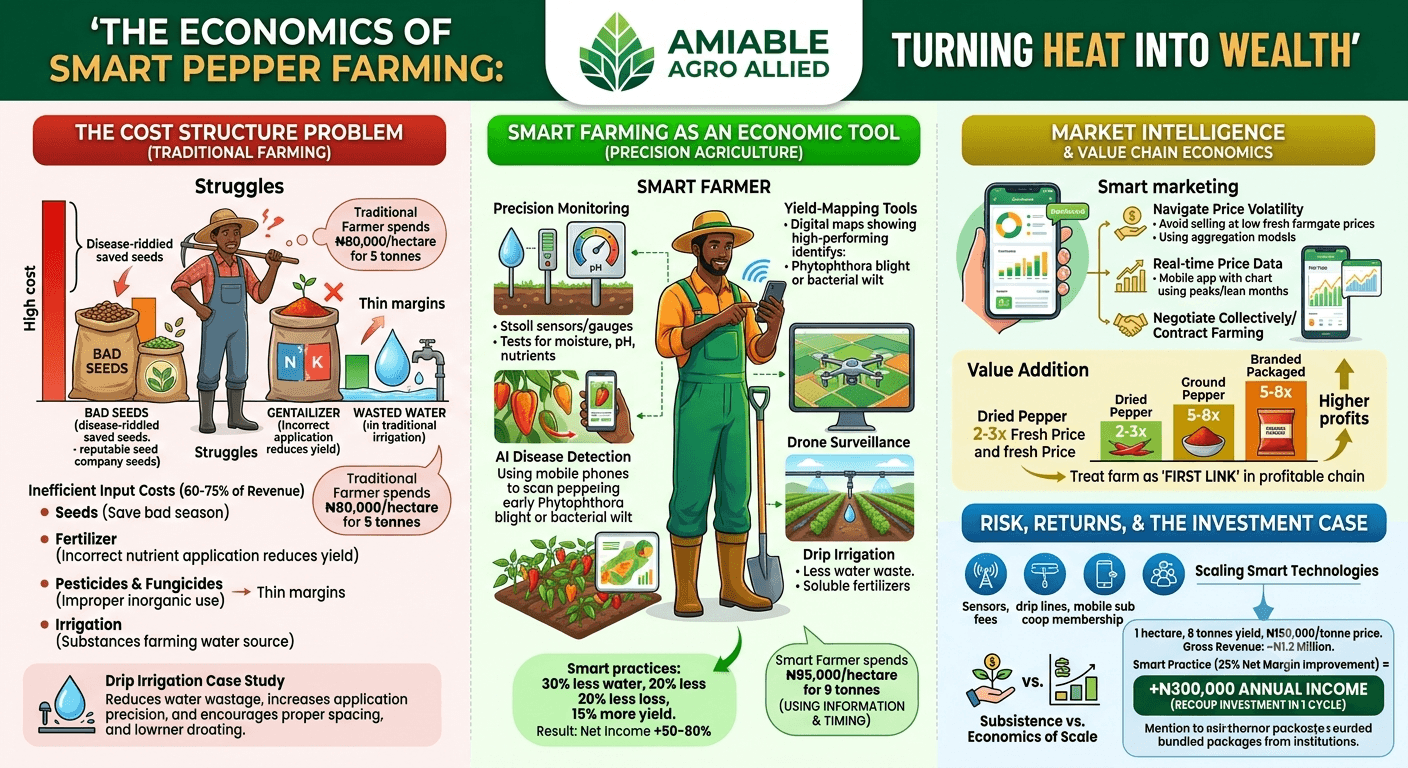
Traditional pepper farming is burdened by inefficiency I.e Input costs (seeds, fertilizers, pesticides, irrigation, and labour) routinely consume 60 to 75 % of revenue, leaving farmers with razor-thin margins that evaporate entirely in a bad season.
✓ Seeds:
The first step to having agood season is having good pepper seeds. Such seeds can be gotten from Reputable seed companies, saved seeds( saved seed should not be planted for more than 2 seasonal cycles so as to not propagate undesirable characteristics, Saving hybrid seeds also is not encouraged )etc. A Bad seed is synonymous to a bad season. Seeds riddled with disease, half eaten seeds or seeds gotten from unreputableseed companies would result in Increased input cost (Fertilizers,pesticides, Fungicides etc), wasted inputs and would eventually thin the revenue margin.
✓ Fertilizer, Pesticides and Fungicides:
Fertilizers, pesticides and fungicides are all inputs that help farmers to increase revenue but only when applied correctly and at the right time. They are almost used incorrectly which causes little revenue for farmers and also has a negative impact on the environment which also affects the farmer. Each plant has its nutrient needs at different stages of development e.g fruiting plants need more of K(potassium) when fruit to ensure more fruits and big fruit. Adding N(nitrogen) rich fertilizer during the fruiting stage doesn't just add to input cost, it reduces revenue because the plant wouldn't produce fruit and already produced flowers would be aborted.
✓ Pesticides and Fungicides are key in preventing and controlling insect pests and diseases but improper use of inorganic pesticides and funicides do more harm than good. Organic pesticides and fungicides (e.g Neem extracts, Trichoderma spp etc) are encouraged as a first resort for pests and diseases not because they are easy to source and inexpensive but pests have dificultyi becoming resistant to them. Inorganic Pesticides and fungicides(e.g Imidaclori, Mancozeb etc.) should be used as last resort for pests and diseases, Active ingredients of inorganic pesticides & fungicides should be changed after every planting season to make sure pests and diseases do not become resistant to it.
✓ Irrigation:
Irrigation is important for a profitable farming, the sub- sharan Africa almost have a conducive weather all year round for crops propagation though some season there may not be rain which mostly serves as source of water for substances farming. Irrigation is the process of providing water for crops asides natural water sources. Drip irrigation system as a case study, though it may be expensive to set up but it has it benefits;
I. It reduces water wastage
Ii. It increases application precision of soluble fertilizers and some fungicides
III. It encourages proper spacing of crops
Water is very crucial for the growth plants, and using one out of the various types of irrigation would help increase margins of revenue.The culprit is rarely the crop itself; it is the imprecision of how it is grown. Blanket fertilizer application, over-irrigation, delayed pest detection, and poor harvest timing all inflate costs while suppressing yields. A farmer spending ₦80,000 per hectare on inputs to harvest 5 tonnes of pepper is operating at an entirely different economic reality from one spending ₦95,000 to harvest 9 tonnes and the difference is almost entirely a function of information and timing.
Smart Farming as an Economic Tool
Smart pepper farming leverages technology to turn guesswork into precision. Soil sensors, soil guage and tests help to monitor moisture & nutrient levels, Ph, and availaible nutrients respectively. Enabling drip irrigation that reduces water consumption by up to 40 % compared to flood irrigation. Drone surveillance and AI-assisted disease detection identify early-stage fungal infections like Phytophthora blight or bacterial wilt before they become field-wide catastrophes, slashing pesticide expenditure and preventing the kind of total crop loss that can bankrupt a small operation. Yield-mapping tools help farmers identify high-performing zones within their plots, allowing targeted input investment where return is highest.
The economics compound quickly. A 30 % reduction in water costs, combined with a 20 % reduction in crop losses and a 15 % yield improvement from optimized fertilization, can push net farm income up by 50 to 80 % without expanding a single hectare.
Market Intelligence and Value Chain Economics
Production efficiency is only half the equation, Smart farmers also make smarter marketing decisions. Price volatility is the defining challenge of pepper economics; farmgate prices for fresh pepper can swing by 200 to 400 % between peak harvest season and the lean months. Farmers who sell at harvest, because they lack storage or market information systematically transfer their margin to middlemen and processors.
Digital market platforms and cooperative aggregation models are changing this calculus. A farmer with access to real-time commodity price data through a mobile app can hold stock, negotiate collectively, or pre-sell through contract farming arrangements that guarantee minimum prices. Pepper processing i.e drying, grinding, packaging further adds value. Dried pepper fetches two to three times the fresh farmgate price, and branded packaged pepper can command five to eight times more. Smart farming integrates this value chain thinking from the start, treating the farm not as an endpoint but as the first link in a profitable chain.
Risk, Returns, and the Investment Case
Smart farming technologies carry upfront costs, technologies such as; sensors, drip lines, mobile subscriptions, or cooperative membership fees. For subsistence farmers, these can feel prohibitive but the economics of scale change the picture significantly. Across a one-hectare pepper plot with an average yield of 8 tonnes and a modest farmgate price of ₦150,000 per tonne, gross revenue approaches ₦1.2 million. A 25 % net margin improvement from smart practices adds ₦300,000 in annual income, more than enough to recoup technology investments within a single growing cycle.
Development finance institutions, agritech startups, and government extension programmes are increasingly recognizing this, structuring input financing, digital tools, and training as bundled packages that lower the entry barrier for smallholder.
✓In conclusion, the economics of smart pepper farming are not abstract, they are grounded in the very practical arithmetic of costs saved, yields gained, and prices captured. What smart farming ultimately offers is not complexity, but clarity. Clearer information about what the soil needs, what the crop is doing, what the market will pay, and when to act. For a crop as commercially vibrant and nutritionally important as pepper, that clarity is the difference between farming as a survival and farming as a thriving business. The future of pepper belongs to farmers who treat their plots not just as fields, but as data-driven enterprises.