
Table of Contents
Introduction
Maize is a cornerstone of global agriculture, yet it faces constant threats from a variety of pests throughout its growth cycle. From the early stages of seed germination to the final development of the ear, protecting your crop requires a proactive and multifaceted approach. Effective maize management is not just about reacting to infestations, but about implementing comprehensive strategies that combine cultural, mechanical, biological, and chemical methods to ensure a healthy and bountiful harvest.
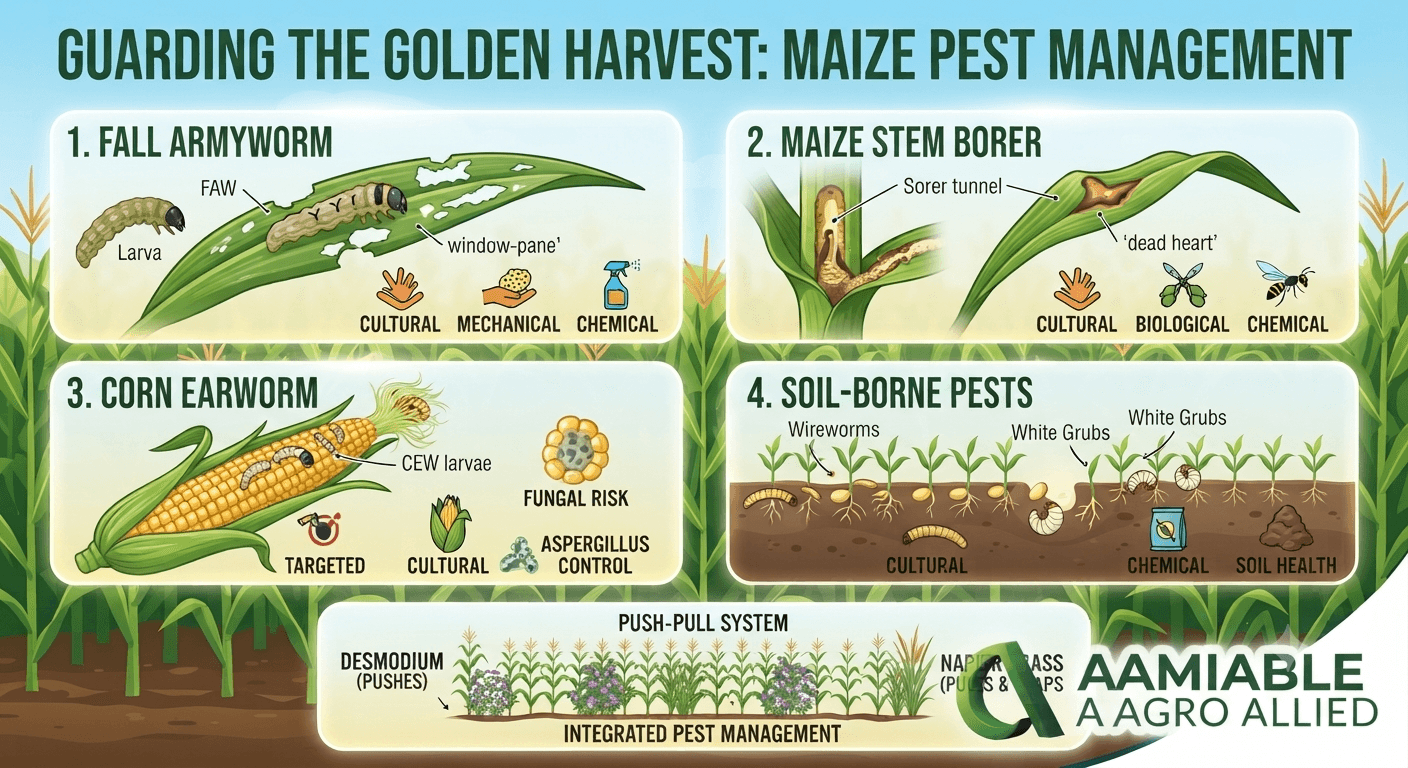
Guarding the Golden Harvest: Maize Pest Management
1. The Fall Armyworm (Spodoptera frugiperda)
The Fall Armyworm (FAW) is one of the most destructive pests globally, known for its high mobility and rapid reproduction—a single female can lay up to 1,500 eggs in her lifetime.
Identification: Look for a dark head with a pale, upside-down "Y" mark. The body features four raised spots forming a square on the second-to-last segment.
Damage: Early signs include "window-pane" feeding marks where larvae consume green tissue while leaving the epidermis intact. As they grow, they move into the plant's whorl, creating large, ragged holes.
Control Strategies:
Cultural: Practice early planting to allow the crop to mature before pest populations peak. Intercropping with "push-pull" plants is highly effective.
Mechanical: For small-scale operations, manually picking and crushing egg masses and larvae can significantly reduce localized populations.
Chemical: Use systemic seed treatments for early protection. Apply foliar sprays containing emamectin benzoate or chlorantraniliprole when larvae are active.
2. Maize Stem Borers
Stem borers are stealthy pests that primarily damage the plant's vascular system.
Damage: They tunnel through the stalk, disrupting nutrient and water flow, which often leads to "dead hearts"—a condition where the central leaf withers and dies.
Control Strategies:
Cultural: Destroy crop residues immediately after harvest to eliminate overwintering sites.
Biological: Encourage natural predators, such as parasitoid wasps, to hunt borer larvae.
Chemical: Apply systemic insecticides early in the season, before larvae successfully penetrate the stalk.
3. Corn Earworm (Helicoverpa zea)
This pest targets the most valuable part of the plant: the kernels.
Damage: Larvae enter through the silks and feed on developing kernels at the ear's tip. This damage often facilitates secondary fungal infections like Aspergillus, which can produce dangerous mycotoxins.
Control Strategies:
Targeted: Apply ear-zone insecticides specifically during the silking stage.
Cultural: Maintain proper fertilization to ensure tight husk coverage, which acts as a physical barrier.
Aspergillus Control: Minimize kernel wounding during handling, store grain at moisture levels below 14%, and practice clean harvesting to reduce fungal inoculum.
4. Soil-Borne Pests: Wireworms and White Grubs
These pests attack the crop before it even breaks the surface.
Damage: They feed on germinating seeds and the root systems of young seedlings, resulting in gaps in the field where plants fail to emerge.
Control Strategies:
Cultural: Rotate maize with non-susceptible crops and avoid planting immediately after sod or pasture.
Chemical: Utilize neonicotinoid-based seed treatments at planting to protect young roots.
Soil Health: Ensure adequate soil drainage, as high moisture can exacerbate grub activity.
5. The Push-Pull System
This innovative biological control method involves planting Desmodium between maize rows (to "push" pests away via scent) and Napier Grass around the field perimeter (to "pull" and trap pests).
Integrated Pest Management (IPM) Summary
Method Strategy Scouting: Inspect your fields at least twice a week. Look for egg masses and early feeding signs
Cultural: Rotate maize with legumes (e.g., beans or cowpeas) to break pest life cycles.
Biological: Encourage natural predators like ladybugs, spiders, and lacewings by reducing broad-spectrum pesticide use.
Chemical: Rotate insecticide "modes of action" to prevent the development of pest resistance. Always wear proper PPE.