
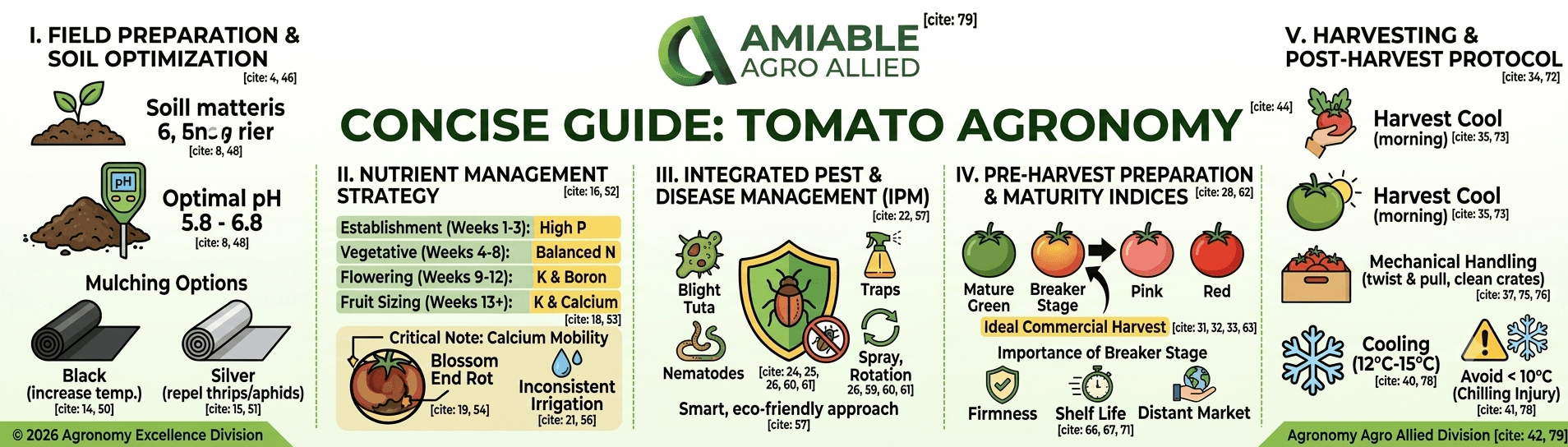
Concise Guide: Tomato Agronomy
INTRODUCTION
"Successful tomato cultivation requires more than just planting seeds; it demands a deep understanding of soil health, precision nutrient management, and proactive pest control. This concise guide is designed to provide growers with actionable, science-based agronomic practices—from field preparation to the critical post-harvest stages—to help you achieve optimal yields and superior fruit quality.
TABLE OF CONTENTS
1. Field Preparation & Soil Optimization
* Soil Chemical Profiling
* Bed Construction & Mulching
2. Nutrient Management Strategy
* Growth Stage Nutrient Focus
* Critical Note: Calcium Mobility & Blossom End Rot (BER)
3. Integrated Pest & Disease Management (IPM)
* Understanding IPM
* Proactive Scouting & Action Thresholds
* Common Pest & Disease Control (Blight, Tuta absoluta, Nematodes)
4. Pre-Harvest Preparation & Maturity Indices
* The "Breaker Stage" Explained
* Importance of the Breaker Stage for Commercial Harvest
5. Harvesting & Post-Harvest Protocol
* Mechanical Handling & Field Heat Removal
* Post-Harvest Cooling & Chilling Injury Prevention
MAIN CONTENT
I. Field Preparation & Soil Optimization
The success of a tomato crop is determined weeks before the first seedling is transplanted. The optimal pH range is 5.8 to 6.8. Raised beds are essential for promoting root oxygenation.
Black-on-Black Mulch: Commonly used to increase soil temperature and suppress weeds.
Silver-on-Black Mulch: The silver side faces upward to reflect ultraviolet rays from the sun, which serves as a natural insect repellent against thrips and aphids, while the black side faces down to retain moisture and suppress weeds.
II. Nutrient Management Strategy
Tomatoes are high-input crops; a split-application strategy is recommended to synchronize nutrient availability with physiological demand.
Establishment (Weeks 1-3): High Phosphorus (P) for rapid root system expansion.
Vegetative (Weeks 4-8): Balanced Nitrogen (N) for canopy development.
Flowering/Fruit Set (Weeks 9-12): Potassium (K) & Boron (B) for pollination and sugar translocation.
Fruit Sizing (Weeks 13+): Potassium (K) & Calcium (Ca) for fruit weight and cell wall integrity.
Critical Note: Calcium Mobility
Blossom End Rot (BER) is typically a physiological disorder. Calcium moves only via transpiration. Inconsistent irrigation causes localized calcium deficiency at the distal end of the fruit.
III. Integrated Pest & Disease Management (IPM)
What is IPM? Integrated Pest Management (IPM) is a smart, eco-friendly approach to crop protection. It combines biological, cultural, physical, and chemical tools to manage pests effectively while minimizing risks to your health and the environment.
The agronomist must implement a proactive scouting regimen. The "Action Threshold" approach ensures chemical interventions are used only when economically necessary.
Early & Late Blight: Managed through copper-based fungicides and improved airflow (via lower-leaf defoliation).
Tuta absoluta: Monitored using delta pheromone traps. Targeted use of Spinosad or Diamides is effective if thresholds are exceeded.
Nematodes: Managed primarily through crop rotation (avoiding Solanaceae for 3 years), use of Nematicides, and the use of resistant rootstocks.
IV. Pre-Harvest Preparation & Maturity Indices
Preparation begins at the "Turning Stage." Agronomists must monitor the "Breaker Stage"—the specific physiological moment when a tomato begins to change color from green to the first signs of pink, red, or yellow on the blossom end. This signal indicates the fruit has reached physiological maturity.
Importance of the Breaker Stage:
* Best stage for harvesting for distant markets.
* Fruits are firm and less likely to be damaged during transport.
* They continue ripening after harvest.
* Reduces post-harvest losses.
* Less cracking and bruising compared to fully ripe fruits.
* Improves shelf life; tomatoes harvested at the breaker stage last longer during storage and marketing.
V. Harvesting & Post-Harvest Protocol
Harvesting should occur during the coolest part of the day (early morning) to remove "field heat" as quickly as possible.
1. Mechanical Handling: Tomatoes should be harvested by hand with a slight "twist and pull" motion. Use plastic crates that are clean and free of sharp edges to minimize punctures.
2. Post-Harvest Cooling: For long-term storage, cooling to 12°C–15°C is ideal. Avoid storing below 10°C to prevent "Chilling Injury," which causes mealy texture and loss of aroma.